Flea Control: Organic Beats Toxic! Cheaper Too!
In a nutshell:
1) don't panic!
Fleas are nothing more than a minor nuisance. Panic can lead to poisons for you and profits for the panic mongers.
2) keep a paper thin layer of DE (diatomaceous earth) wherever a vacuum cannot reach
3) vacuum once every three days, tossing a little DE on the floor first
4) if you have a pet:
flea comb every three days (every day if fleas are found)
wash bedding every three days
5) do not use toxic gick!
No flea bombs, no boric acid, no borate powders (and this definitely includes the fleabusters product), no flea collars, no pyrethrins.
Now for the verbose details ...
Don't Panic!
Marcia Larkins, D.V.M., chief of the companion and wildlife drugs branch in the FDA's Center for Veterinary Medicine says fleas are "Just a nuisance. They generally cause a lot of itching and scratching. They may also cause some discomfort due to possible allergic flea bite dermatitis."
You're going to be fine. Fleas are nothing more than a minor nuisance.
Yes, they do bite people. Yes, they did help spread disease hundreds of years ago - but they need a source of disease to spread it - and that is, these days, virtually unheard of in North America. I think that horse flies and mosquitoes are about a thousand times more dangerous - mostly because they can go get disease from far away and bring it to you. How freaked out do you get over a mosquito bite? And if you have a flea problem in your house, those fleas can only bring to you disease that is already in your house.
You're going to be fine. Fleas are easy to control cheaply and organically.
I hesitate to mention the plague, but it is a tool that the fear mongers use. And this is, by far, the scariest thing possible with fleas, so let's take a proper look at it.
To get the plague you also need rodents. But not just any rodents, the rodents must have the plague. The fleas must bite the rodents and then bite you. Since fleas don't travel far, and this page is about controlling fleas in your home, you would have to have rodents with the plague in your home. Nearly all plague cases involve rodents living far away from people's homes. Therefore, the odds of you getting the plague from a flea in your home is about one in a skillion jillion. You have a better chance of being elected president and then getting hit by lightning on your first day in office.
From the Center for Disease Control: "human plague in the United States has occurred as mostly scattered cases in rural areas (an average of 10 to 15 persons each year). ... Most human cases in the United States occur in two regions: 1) northern New Mexico, northern Arizona, and southern Colorado; and 2) California, southern Oregon, and far western Nevada." And nearly all of those cases were in undeveloped areas. Usually undeveloped land far from most people. The people that do catch the plague are often researchers studying the rodents.
Since this is the scariest thing that can be thrown at you, do I really need to talk about anything else the fear mongers will try to toss your way in order to scare you into parting with your money?
I wonder how many people die every year from flea poison? I'm having a hard time finding that data, but I did find this anecdotal report: From http://www.prescriptionbeds.com/people_sick.htm "My good friend acquired asthma after prolonged exposure to boric acid. (carpet treatment) Subsequently, she died from an asthma attack. This happened over a period of two years!!!"
I have to say "don't panic" because I have personally witnessed panic. And this panic led to dropping $560 for "natural" toxic gick that came with a "guarantee" to be free of fleas for a year. And yet the fleas remained. And then the panic went way beyond that and everybody moved out of the house.
Panic means profits! It is scary how easily people will panic and then do all sorts of unreasonable things. And there are lots of less than ethical folks out there stirring up the panic so they can make money. Don't be that gullible!
You're going to be fine. With a little knowledge, a little time and about 20 bucks, the fleas will be all gone.
Know your enemy!
Wikipedia has some good info. At the time of this writing, it is pretty accurate and I expect it will become more accurate as time passes.
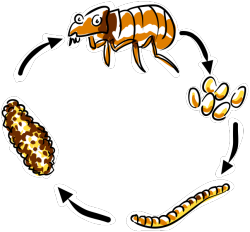
There are four stages in a flea's life: egg, larva (maggoty-like-thing), pupa (in a cocoon) and adult.
Egg-to-egg life cycle is usually two to four weeks. Under the right conditions this can be a little shorter (12 days), or much longer (8 months).
An average fertile female flea lays about 200 eggs per month and 500 eggs over her entire lifespan. Some folks want to shock you (panic means profits!), so they compound this tidbit of data along with the life cycle information. So, suppose you have a flea worthy of the flea olympics and can lay 500 eggs per month - a real performer! I'll name her Helga. And combine with that the perfect flea nursery so that those eggs can become adults in, say 14 days. So, on day one, Helga has an amazing day and lays 50 eggs! Helga's best performance ever! 14 days later, Helga's bratty kids pop out as adults. Flea sex. Eating. And then each brat squeezes out 50 eggs. Helga is so proud! So, that's 2500 eggs. 14 days after that you have 125,000 eggs! You could then say "a single flea could be responsible for 125,000 eggs in one month!" Sunnuffabitch! Where's my checkbook!
A quick pass at some rational math. Let's say that Helga lays a more realistic 12 eggs. And we will go ahead and assume that half of those will hatch as male fleas. So at the two week point there are 6 females laying 6 more female eggs. So at the end of the month there are 36 females laying 12 eggs each. 432 eggs at the end of the month.
Further, this is assuming a lot of optimal things about the mating, finding food, the optimal egg, larva and pupal environment, the fastest possible egg-to-egg cycle with no consideration for mortality at all of the different stages.
The reality check is that it's a hard life to be a flea. The larva compete for food (their favorite food is flea poop, but they'll eat most forms of organic matter). In a clean house, it can be so difficult to find food, that hardly any larva become pupa. Hot and/or dry conditions can be deadly too.
For a small, one bedroom filthy house with five filthy cats, and nobody ever does anything about it .... I could see a breeding pair of fleas growing to a family of 50 in a month. Left without intervention, I could imagine a maximum of a thousand adult fleas living there. 50 to 100 per cat, and the rest looking for a host.
In my worst flea situation, I don't think there was ever more than 30 adult fleas alive in the house at one time.
So the important thing to keep in mind here is that if you keep a clean house, you're probably not going to be dealing with more than a few dozen fleas at any given time.
On with the flea trivia ....
A flea cannot jump higher than eight inches (hundreds of times their own height!).
My understanding is that a flea will sit in the pupal stage for a long time waiting for a host to come by. Then suddenly leap out and ... boing! boing! boing! boing! boing! boing! and grab! On the host! Sometimes they miss. And if they miss, they have about one week to find food (blood) or they die.
A female flea has to consume blood before she can lay eggs.
The female will usually lay eggs on the host and the eggs then roll off of the host as the host moves about.
A flea can hitch a ride on a human. You could get fleas in your home and have no pets. You would then be the flea's only food source. And you thought you were at the top of the food chain!
When a flea bites you, you probably won't even notice. What you do notice is your own immune system reacting to the flea's saliva (complete with anti-coagulants and some antigen proteins). The important thing here is that you might feel the itch two or three times! This can make you think that you have been bitten two or three times, but really you've been bitten just once. If you don't sense the actual bite (and you probably won't), the first itch comes about five to six hours later, and the second comes 24 to 48 hours later. So chances are that you feel the itch and think you have been bitten just now - but in reality, that flea came and went hours ago. Lots of people come to the errant conclusion that there are fleas in a room or in a house because of this. The only way to know where fleas are is to see the actual flea.
Some people say that fleas don't bother them. My understanding is that the fleas still bite them, but they just don't have an allergic reaction to flea spit, like 90% of humans do. That's what that little red dot is: an allergic reaction to flea spit. If you have the red dot - you're allergic!
Diatomaceous Earth
According to wikipedia: "fossilized remains of diatoms, a type of hard-shelled algae."
This is an off white powder that feels a bit like flour. Not only can you eat it, it is already in a lot of the food that you eat.
I have heard two explanations of how it works.
One is that on a microscopic level, the particles are very sharp looking. These particles stick to an insect and get stuck between its exoskeleton joints. As the insect moves, it gets physically cut up.
The other explanation is that it sticks to the insect and somehow causes them to dry out. I think this approach involves scratching the insects waxy layer which then allows precious moisture within the insect to get out.
A reader, Sue, in Washington state writes:
Both are true and connected. DE is almost pure silica (with some beneficial trace minerals); under a microscope, it looks like shards of glass (glass is made from silica). On any beetle-type insect that has a carapace, like fleas and cockroaches, the DE works under the shell and punctures the body, which then dehydrates and the insect dies. DE is totally nontoxic. There is no buildup of tolerance like there is to poisons because the method of killing is PHYSICAL, not chemical.
The important thing to us is that if an insect with an exoskeleton gets DE on them, they die. At the same time, we can rub it all over our skin, rub it in our hair, eat it .... whatever ... and we are unharmed.
Farmers dump DE by big scoops in with grains when the grains are stored. It kills the insects that want to feast on the grain. This is a great improvement over the stuff they used to put in with the grain.
Farmers feed gobs of it to animals in the hopes that it will cure whatever ails them. Many farmers swear that the stuff kills all sorts of worms in their critters.
The only concern about this stuff is that if you throw it into the air, you can make a big cloud of the stuff. Breathing that in can irritate your lungs. Just as breathing in anything other than pure air can irritate your lungs. The same concern applies to pastry flour, talcum powder, corn starch or dust on the wind from outside. The dust that gets into the air from emptying your vacuum cleaner bag is probably far worse for you than DE dust.
I've heard of some folks intentionally making a cloud of the stuff in a room to make sure the DE gets into everything. If you're going to do this, you should probably turn appliances off first so that their fan stuff doesn't get plugged with the dust. I don't go this route - all that dust makes me cough.
I try to make a paper thin layer of DE wherever the vacuum doesn't reach easily and use the vacuum technique (below) also. That way, when an adult flea jumps out of its cocoon, instead of going "boing! boing! boing! boing!" it goes "piff! piff! piff! piff! urk!" I don't throw it around - more like lay it about and then spread it around slowly with my hand. Kinda like finger painting.
Note that DE works only on the adult stage of the flea. (Some say it works on the larval stage too) So while traveling this road, be thinking that there are lots of eggs, larva and pupa around still. The strategy is to kill the adults before they lay more eggs. If we assume that DE works so good that the lifespan of an adult flea is one minute, then you will continue to see adult fleas for the next two to four weeks - from the eggs already laid. They just won't live very long.
Make sure you buy "food grade" DE. There is some stuff used for swimming pool filters. Don't use that. There are some other varieties of DE that are labeled just "Diatomaceous Earth" but they have other stuff added to it. Icky stuff. The "food grade" DE is pure.
A great thing about DE is that you can leave it around the edges of your home and in hard to reach places for months or years. As long as it doesn't get wet, it will continue to work.
One time I had some fleas in my room and I just put down DE. I did nothing else. I then put it out of my mind. Two days later I checked my ankles and had no new flea bites. I vacuumed up all of the dust about two weeks later, and set out a flea trap (see below). I caught one flea, then I went to the DE-along-the-edges and vacuum approach combined with a flea trap every night. The flea trap did turn up a flea once in a while for two weeks, and no more after that.
My first attempts at DE on carpet were to just sprinkle and not spread it to make a paper thin layer. This had mixed results. My sprinkle without spreading, covered about 20% of the surface. Mathematically, this means that the average flea lifespan is five times longer (if a flea has to touch DE 5 times to die, then that would be 5 hops with full coverage and 25 hops on average with 20% coverage). Some fleas might then live long enough to bite. Possibly long enough to lay eggs. Not good. The paper thin layer has 99% coverage and no bites were experienced.
I have heard from two people that said that they won't use DE anymore because "the tiny particles cut my lungs!" --- (deep sigh goes here) All I can say is "Did you actually examine your lung with a microscope and watch the DE cut into it?" - of course, they did not. I think the truth behind these reports is that these folks heard how DE works, and when they would breath in the dust, it would make them cough - just as breathing in flour or corn starch would make you cough. And then they thought of the sharpness at a microscopic level. My understanding is that when DE becomes moist, the sharp thing is no longer happening. That's why you have to keep it dry when you use it.
I have encountered over a dozen ignorant boobs that have proclaimed "Diatomaceous Earth does NOT work!" I have read this statement in all caps. In extra big fonts. With italics. And I've even had it screamed at me. I'm gonna stick with "ignorant boobs". On closer inspection of each case there is always a flaw. Usually the problem is that it was not used correctly. If you put it in one place and hope the fleas are drawn to it to die, I have found that strategy sucks. Another flaw is to use it correctly, but there are still eggs hatching and fleas come out of the pupal stage. The DE hasn't had a chance to do its magic yet. I kinda wonder if the pesticide companies pay people to go to internet forums and say this sort of thing. DE is super cheap, non toxic, and generally more effective than anything the pesticide companies have to offer - so it kinda cuts into their profit margins a bit. I've been meaning to create an experiment to set the record straight on this topic, but a participant in the forums here, Stephanie, beat me to it:
I tried my own experiment with the DE to see how quickly it kills the fleas; I caught a few fleas and put them in a jar with a pinch of DE - all were dead within just a couple of hours.
How to get diatomaceous earth? Well, I've managed to find it in lots of places. Some farm supply stores carry it. Most don't. Some hardware stores carry it. Most don't. And there are, of course, LOTS of internet souces for it:
dirtworks.net is on the eastern side of the US. If you buy from them, make sure you get the stuff called "Fossil Shell Flour/Diatomaceous Earth". They sell other DE things that contain other stuff - I recommend AGAINST getting the other stuff. One cool thing about these guys, is that the owner/founder participates in our forums a lot and is a fountain of excellent information!
groworganic.com in on the western side of the US. I have ordered stuff from these guys about a dozen times. They're great. But at the time of this writing, they have only one DE product I trust: 50 pounds of food grad Diatomaceous Earth. That's a helluva lot of DE. And good luck with the shipping on that!
ppcsupplies.co.uk in England. These guys wrote to me to say they really like this article and to point out that people in England sell DE too! Here is their Diatomaceous Earth product.
Vacuuming
This assumes that you have carpets.
One of the things that convinces a flea that it is time to leave the cocoon and jump on a host is vibration. And a vacuum provides one helluva vibration! If you toss a little DE on the floor before vacuuming, then the flea ends up in a cush pile of DE in the vacuum bag.
If you are going to vacuum less often than once every three days, you should probably spread DE all over the floor between vacuuming.
If you are experiencing a LOT of fleas, you might want to vacuum once or twice a day just to be comfortable.
Light Traps (aka "Flea Traps")
These things feed my inner scientist! (evil, maniacal laugh goes here)
Fleas are so small, often the only way to measure success is whether you are still getting bitten. So this simple trick is a great way to not only kill fleas, but to monitor your progress.
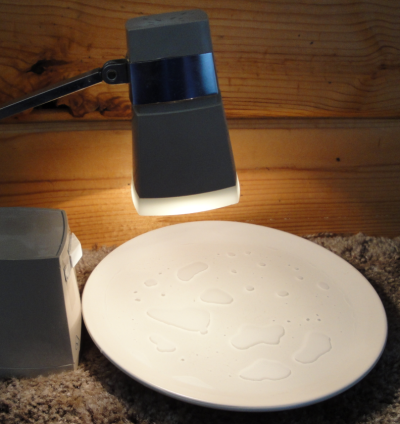
Just a little lamp next to a plate of soapy water. Fleas are of an insect family that is drawn to light. They're just stupid that way. And fleas drown easily provided that you disable their mechanism to deal with water (that's what the soap does).
Set the trap out at night. Count the number of dead fleas in the morning. This is the best way to measure how your efforts are working. You don't have to wear a white lab coat and horn rimmed glasses if you don't want to. If you don't have engingeering paper on a clipboard, you can use the back of an envelope.
If you are doing a good job with the DE approach, then during the first couple of weeks you should see fleas in your trap every night. After two or three weeks the numbers should start to drop a lot. Around four weeks the numbers should be zero. I would continue monitoring for four weeks beyond the sight of the last adult. After all, what if that adult managed to lay eggs before dying?
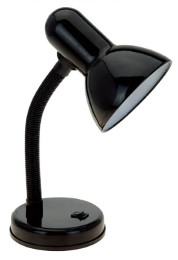
A desk lamp is the best. It can focus the light into a small area, rather than illuminate the whole room.
If you are setting many traps each night, we've found the easiest thing to do is to put dry plates on the ground and pour soapy water into the plates.
I think that light traps alone probably won't be a complete flea control solution. Even if you used lots of them every night, they would probably only kill 95% of your population. That remaining 5% can go on reproducing. DE is going to be your real workhorse.
If you have a pet, don't think that using the light trap takes the place of using a flea comb. The light attracts fleas that are looking for food. The fleas on your pet are living on the food.
Dehumidifier
I'm having a hard time coming up with any really hard research on this one, but I am finding a lot of anecdotal success.
My understanding, from some pretty weak sources, is that this does work on all stages of a flea's life.
Apparently, fleas require 50% or higher relative humidity to live. They prefer 70% or higher. Think about it: all life requires water. Fleas can survive in a house, but where do they get their water? The only source is the air, and apparently they need plenty of it or their innards quickly turn into flea jerky.
As I examine my own history .... the only time I have had to deal with fleas was when living in Eugene, Oregon (moist with mild temperatures) and in Seattle, Washington (moist with mild temperatures). In all other places (mountain desert) I let cats and dogs in and out of the house willy nilly and never gave a thought to fleas. I think this is a strong indicator of how fleas thrive in humidity and are almost non-existent where it is dry.
I have now tried this dehumidifier trick on two rooms:
Room 1: A housemate captured seven fleas by hand in about an hour and drowned them in soapy water. We moved the dehumidifier into his room and ran it for two days with nobody living in there. We entered the room only to empty the water from the dehumidifier. We then put flea traps in the room every night. No fleas. The dehumidifier appears to have worked very well. But note that this is a very small room. By September 2007, I should post the longer term results here.
Well, it is now April, 2008 and that room has been flea free since I wrote the above in July of 2007. In fact, the whole house has been flea free since about a week after I wrote this article.
Room 2: This much larger room had DE on the floors and was getting vacuumed daily. It had a serious flea problem at one point. There were two traps. The night before putting in the dehumidifier, the traps had caught two fleas each. The dehumidifier was run for two days with nobody living in the room. We entered the room only to empty the water. Immediately afterward, six fleas were caught. Another round of heat (93 degrees F max) plus dehumidifier was done. The next day two more fleas were caught. So this experiment didn't work. I think that the size of the room is a factor. Either the dehumidifier needs to run longer, or a more more powerful dehumidifier is needed.
I don't yet have the confidence in this that I have in DE, but I think there is a lot of potential. I just need to do more experiments. Hmmmmmm .... I think I need a way to test relative humidity ...
My reading suggests that this works on nearly all critters that don't drink water. There are some dehumidifiers sold specifically for controlling problem insects in a closed space.
A possibly worthwhile note: most of the work done by an air conditioner is to dehumidify.
Heat
This is one that I have not yet properly tried, but it has actual science behind it and it just sounds cool (pun?).
A flea cannot survive 103 degrees F for one hour. My reading suggests that this impacts all stages of a flea's life. My thinking is that you would want to sustain a temp of about 108 for at least four hours - just to make sure that the temperature penetrated all of the hiding places.
On one web site, a guy said that he turns his thermostat all the way up (about 90) and leaves for the day. He comes home and there are no more fleas.
I would think that if I were to try this, I would want to unplug a few things first (computers mostly). I think picking a day that is already hot outside might save energy in this project.
I gave this an initial try. My portable heaters have a thermostat built in. I couldn't get the temperature in the room above 93. I probably sustained that temperature for six or seven hours. Two fleas were caught in that room the next day. I need to find another way to heat this room and perform this test.
Shampoo (or steam clean) your carpet
Another one I have not tried.
The theory is that fleas drown easily in soapy water. And they don't cope with heat well either, so the steam cleaning would be even better. This should also remove more flea poop - the flea larva's favorite food.
My reading suggests that this impacts all stages of the flea's life.
Note that once DE is wet, it won't work anymore.
Note also that there are some folks that say this doesn't work because
the fleas are not under water long enough to drown
fleas like warm and moist, and you just gave them moist
you can't get to the fleas in the edges, and, possibly, some nooks and crannies, where a lot of the fleas live in the earlier stages. So if shampooing works, it won't kill the fleas in the edges, nooks and crannies, and then those fleas have a fantastic, moist environment to move into.
Wash your clothes/bedding
If your clothes are on the floor, they could be harboring fleas in one of the many stages. A trip through a washing machine (with soap/detergent) will kill all fleas in all stages. Pretty easy.
During the days of flea trouble, it would be wise to keep your room(s) clean and do all of your laundry at least once a week.
If you have flea bites above your knees, the fleas are in your bedding. Wash all of your bedding. Your comforters and blankets might need to go for a ride in those big, front loading things at the laundromat.
I never heard of dry cleaning doing anything to fleas, so if you have wool or down, I think you're going to have to go with a very gentle cold wash followed by air drying with no heat.
Critter Care
If you have a critter (dog, cat ... ferret ... etc.) that has become a home to fleas, the first thing you need to do is use a flea comb. Comb the animal in such a way that the fleas and eggs will end up outside or in soapy water. That way, the fleas don't just jump back onto your pet two minutes later.
Optionally, once a week, dunk your critter in warm water with a mild soap for about five minutes. It might help to wrap the critter tightly in a towel first to prevent squirming. Just dunk the critter and the towel. When you do this, be prepared for fleas to make a dash for the head - be prepared with the flea comb. Wet fur can often expose more fleas. Pick them all off.
Wash your pets bedding every few days and (optionally) dust with DE. You can even work the DE into your pet's fur if you like.
A reader, Sue, in Washington state writes:
I live in a flea paradise: warm and humid. At the first sign of a flea, I dust all my pets with DE, working it down to the skin. I do this weekly or every two weeks, mostly depending on the type of the animal's haircoat. My dog has a thick coat (Belgian Tervuren), and one cat has a bushy coat. I do them every two weeks. The smooth-haired cats I do every week, as I suspect their usual grooming removes the DE faster.
Then I dust their bedding. Then I use a small-mesh wire sieve and lightly dust my carpets with the DE. Since the DE does tend to fly when I do the carpets, I use a simple drugstore face mask to protect myself.
I've been using DE for three years. A friend of mine that has 16 unadoptable cats from a rescue operation uses it, too.
DO NOT USE POISON!
I think this topic is large and obvious. Just take a look at the warning labels if nothing else. In nearly every case, you end up poisoning yourself and your family along with the fleas.
If you think I'm out of my gourd, please google "MSDS" and the name of your product of choice to get the facts BEFORE you poison yourself. "MSDS" is the "Material Safety Data Sheet" that is required by law to be provided with the product. Although it turns out that actually providing that material cuts way back on the sales of these products, so it is "forgotten."
Use your brain before your poison lowers your IQ by 20 points.
DO NOT USE Borate Powder
This is an edge case poison. Often pushed as "natural" or "least toxic". I discuss it in detail here because, while it is a lot less toxic than other stuff, it is still toxic and if you are considering using it, you should get a grip on just how toxic it is.
This stuff travels under a lot of names: Boric Acid, Fleabusters, Sodium Polyborate, Borax, Sodium Borate, Sodium Tetraborate, Disodium Tetraborate, Boracic Acid, Orthoboric Acid, Acidum Boricum and many other names.
Because this stuff is far less toxic than most other poisons, a lot of ignorant environmental groups have pushed it as a solution. Of course, you need lots more of it (compared to the stronger poisons) to work against fleas. So in the end you may be about equally poisoned.
Since this stuff can occur naturally, it is sometimes marketed as a "natural" product. Well, there are lots of powerful poisons out there that occur naturally (arsenic, cyanide and asbestos come to mind), that doesn't mean it's a good idea to bring it into your home and expose yourself to it.
A fascinating article at http://www.unexco.com/boric-op.pdf. As it introduces part 2, it says "Part I of Mr. Cartwright's article addressed the use of Boric Acid (the main ingredient in many flea control products such as Fleabusters) in a method that is inconsistent with that recommended by the manufacturer * -- i.e. broadcast application, or spreading over a large area where there will be constant direct contact. This type of application can lead to exposure to the chemical which can have harmful effects. Particularly susceptible would be children and animals."
* In this case, "the manufacturer" is "U.S. Borax"
Mr. Cartwright then says "U.S. Borax has the only correct Material Safety Data Sheet (MSDS) on boric acid that I have seen to date. Most, if not all, other manufacturers of pesticides that contain boric acid have incomplete information contained in their MSDSs about boric acid and/or borates."
check the MSDS at http://www.anvilfire.com/21centbs/material/33850-usborax-borax.pdf
Here is an excellent, scientifically backed, article on Boric Acid and Borates Toxicity
DO NOT USE Pyrethrins/Pyrethrum
This is another edge case poison. Like borates, it is often pushed as "natural" or "least toxic". I discuss it in detail here because, while it is a lot less toxic than other stuff, it is still toxic and if you are considering using it, you should get a grip on just how toxic it is.
From this fantastic document on Pyrethrin/Pyrethrum Toxicity: "Pyrethrins are a common cause of insecticide poisonings. According to a U.S. Environmental Protection Agency
(EPA) survey of poison control centers, they cause more insecticide poisoning incidents than any other class of
insecticides except the organophosphates. Symptoms include headaches, dizziness, and difficulty breathing."
DO NOT USE Flea bombs
Think about how they work. They put poison on everything. If you touch a wall and then eat a grape, you just ate poison. Of course the product is labeled to say that you need to clean everything afterward so that you don't poison yourself. Somehow I doubt folks clean everything that the flea bomb can reach. And besides, isn't the whole idea with the flea bomb is the convenience? Just set it off and come back the next day. Cleaning EVERYTHING doesn't sound really convenient.
My reading suggests that for the flea bombs to work, you need to set a new one off once a week for three to six weeks. That's a lot of poison. And even then. some people say that the fleas are still not gone.
DO NOT USE Flea collars
Pretty straight forward. Poison on your pet.
And they stink!
Summary
With hardwood floors, I just toss out a little DE in the nooks and crannys. With carpets, you need to add in some regular vacuuming with some DE mixed in. The light traps help you to make sure you are making good progress. After the fleas are gone, keep a little DE in nooks and crannys and in pet bedding - just as a preventative.
I have great hopes about the dehumidifier and the heat approaches. We'll see what information shows up on these fronts over the next few months/years.
Fleas are nothing more than a minor nuisance and are easily controlled with with some really cheap, safe products and a little patience.
Comments? Questions? Rude gestures?
click here!