richsoil.com
home
barbed wire
lawn care
soil pH
flea control
barbed wire
ants and aphids
pig care
typical project
farrowing hut
hugelkultur
fence doughnuts
barbed wire
cast iron
sourdough pancakes
barbed wire
permaculture forums


    using a cast iron skillet ain't so hard!

    I have learned so much in the last couple of months. A big part of what I have learned is that what I thought I knew was a load of horse potatoes. I still have several things to get straight in my head before I can rewrite this article. In the mean time, I decided I should at least correct what is posted here.

    I want to thank Dan Abadie, a chemist and cast iron aficionado, for helping me to understand the details of this stuff.

    My more recent, corrective notes will be in red.

    in a nutshell:

      1) never use soap!

        Go ahead and use soap. Just don't use your seasoned cast iron to MAKE soap! The lye will destroy the seasoning.

      2) never use water for more than a few minutes

        Using water short term has its uses. When the time comes to put the pan away, give it a few seconds on a hot stove, just to make sure all the water is out.

      3) use a little oil or grease - don't let it smoke!

        A little smoking is actually a good thing!

      4) too much heat on an empty skillet can ruin the surface or even crack the pan

      5) clean immediately after each use leaving a very thin layer of oil/grease

    Now for the verbose details

    A lovely homage to a cast iron skillet:

          Do you have a black iron skillet? You are a southern mountain girl, I can't imagine you would not. Put it on the kitchen table. Turn on the overhead lights.

          Look into the skillet, Clarice. Lean over it and look down. If this were your mother's skillet, and it well may be, it would hold among its molecules the vibrations of all the conversations ever held in its presence. All the exchanges, the petty irritations, the deadly revelations, the flat announcements of disaster, the grunts and poetry of love.

          Sit down at the table, Clarice. Look into the skillet. If it is well cured, it's a black pool, isn't it? It's like looking down a well. Your detailed reflection is not at the bottom, but you loom there, don't you? The light behind you, there you are in a blackface, with a corona like your hair on fire.

          We are elaborations of carbon, Clarice. You and the skillet and Daddy dead in the ground, cold as the skillet. It's all still there. Listen.

              -- Hannibal Lector sends a letter to Clarice Starling in "Hannibal" by Thomas Harris

    Cooking with cast iron is one of those things where I failed utterly and repeatedly until I finally reached out to people for help. While the mighty internet had lots of advice, my eggs still stuck! I needed the collective wisdom of dozens of people to just be able to fry an egg without a big cleanup job. I can now get that egg to slide off the skillet every time. This article is my feeble attempt to relay what I have learned so far.

    First, I want to emphasize that getting stuff to slide right off of cast iron is easy - once you get the hang of it. A little knowledge and a little practice will give you a skillet that will last a lifetime and will never poison you.

    Why use cast iron?

    There are many things that drive me to use cast iron:

      I'm convinced that "non stick" surfaces, such as teflon, are toxic. Newer products come out that sound better, but I cannot help but think that folks just have not yet learned how toxic the new surfaces are. At the time of this writing, I feel comfortable cooking with iron, some steels, and glass. I avoid all chemically treated cooking surfaces, aluminum and copper.

      Cooking with cast iron helps folks get more iron in their diet to build more red blood cells. Doctor's recommend that those with anemia cook with cast iron.

      Many of my happiest memories involving cooking, involved cast iron. I remember my grandad cooking almost everything we ate in a cast iron skillet.

      Using cast iron is a skill from a simpler time.

      Cast iron can last hundreds of years. Many moderm skillets/griddles last only a few months to a few years.

    Start with a good piece of cast iron

    I bought a new cast iron skillet at some department store. I cleaned it, seasoned it, used lots of oil ... sometimes it worked, sometimes it didn't. I gave google a big workout and I found lots of internet forums to ask lots of questions. The feedback was to take a close look at the cooking surface of this new pan. It's rough. Apparently, long ago, there were two grades of cast iron one could purchase. The first is where hot iron is poured into a mold and that's it. The second is where they take the first and machine out the cooking surface to make it much smoother. But that machining process usually doubles the price.

    Today's new cast iron is all the first kind. The surface is rough. I shopped around for a long time to try and find something new with a machined surface. The closest thing I found was a griddle made from sheet steel.

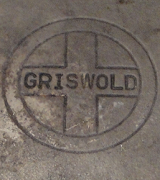
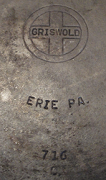
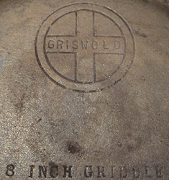
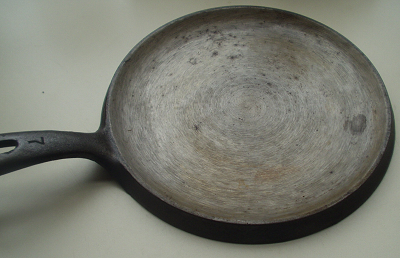
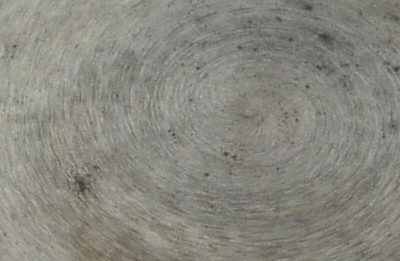
    Many of the experienced cast iron folk recommended buying a heavily used skillet. The most popular brand being "Griswold" - a company that went out of business in the 1950's. Not only were these skillets machined, but if they were heavily used, their cooking surface would be downright glassy!

    I bought a Griswold number 10 skillet for $20 plus shipping on ebay. This was a big improvement over the new skillet. I have to mention that I tried to buy a similar skillet for a friend a few months ago and the price was more like $50!

    I also bought a new skillet and spent about two hours grinding the surface with all sorts of different sanders designed to smooth metal. That was messy and a lot of hard work. The skillet worked okay for a few weeks and then cracked.

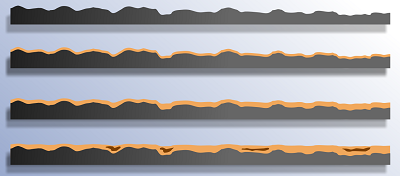
    I think a person could buy a new skillet, follow all of the advice on this page and if used twice a day for six months it would probably be just as good as an old skillet. The most important ingredient would include the use of a stainless steel spatula with a flat edge: as it is used over and over, it will take the "peaks" off of the rough surface as the "valleys" fill with "seasoning". (more on this spatula below)

    I think the best thing to do is to buy a Griswold skillet from ebay (try for a number 10 skillet for about $35 plus shipping). The other techniques are just too much work or add too much frustration. I've bought stuff with a lot of crusty stuff that I managed to get off with a fire. And I've bought stuff that was seriously pitted that seems to work okay - although I far prefer the stuff that is not pitted. I see ads mentioned "no warp" or "not warped" or "level" and am grateful that I have yet to encounter this sort of thing. There are people that collect Griswold cast iron, so there are sometimes pieces that have something interesting going on that sell for something like $500!

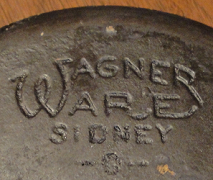
    This might be a good time to point out that I also picked up a Wagner brand cast iron skillet for a dollar at a yard sale last summer. It seems like the iron is a little thinner, but it works great!

      Dan thinks that thinner is better. Not sure why.

    Seasoning cast iron

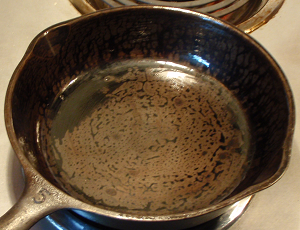
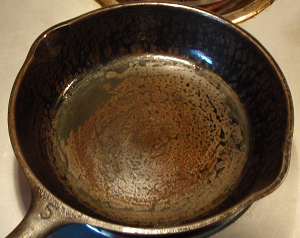
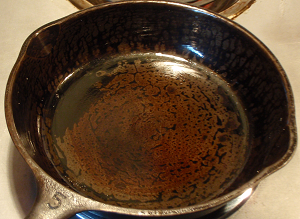
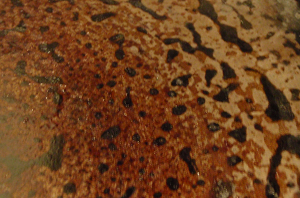
    "Seasoning" is the act of creating a hard layer of petrified oil/grease on cast iron or steel. Maintaining a good seasoning is the most important aspect of keeping stuff from sticking to cast iron. Each time you cook with oil/grease and don't have to scrub the pan afterward, you probably add another layer. Scrubbing, scratching or soaking the pan in water probably removes many layers. Some layers of seasoning are better than others. What makes better layers probably has to do with what kind of oil/grease was used, what temperature created the layer and how thick the oil/grease was when it was put on. A well seasoned pan will have dozens of very thin, very hard layers. So many that the pan will appear to be black instead of the silvery gray of the raw cast iron.

      Dan confirms that this stuff about the layers is all true.

    I think the best way to season a cast iron skillet is to use it. In the beginning, you might use a little more oil/grease than you would normally use - just to make sure that you don't have to scrub afterward. Once you have some seasoning layers built up, you can use less oil/grease.

    Most folks believe that "seasoning" means that you put some oil/grease on the pan and bake it. Seasoning recipes include varrying temperatures from 100 degrees to 550 degrees. And processes from an hour to several days!

    If I was gonna try this sort of bake style seasoning again, I would:

    • put on a thin coat of oil/grease.
    • put the pan upside down in a cold oven, with an oven safe coffee cup under one edge - forcing the pan to be un-even so that the excess oil will run off.
    • Put foil under the pan to catch any dripping oil.
    • Bake at 500 degrees. It's okay if it smokes.
    • After an hour, turn the oven off, leave the door closed, and leave the pan in the oven for a couple more hours.

    Lately, I've been adding seasoning layers by baking corn bread in my skillet! I just add a little extra oil to the corn bread batter just to make sure it doesn't stick.

      I'm not so sure about the cornbread thing anymore. Dan says the oil needs to smoke. I don't think it gets hot enough with corn bread for most oils.

    I became a bit obsessed with understanding this stuff and was getting more confused by the minute until this fella Alan straightened me out in a forum: "What you want is a layer of heavily polymerized fat which typically includes a fair bit of carbon black bound up with it." So it is polymerized fat which is hard and slick. The carbon is the black stuff. A couple of chemistry savvy friend explained to me that "polymerized" means that the substance re-arranged its molecules to be in a different state (I hope I have that right). In this case, slick liquid oil becomes slick, rock hard solid oil. Apparently, this is very similar to how paint works.

      This is the beginning of my education. It turns out that there are an infinite number of kinds of seasoning layers. It depends on the oil, the temperature, the duration of the heat. Some have lots of carbon, some not so much. Some make a glassy layer and some make a "sticky" layer that turns squirmy slick when heated. Some stick to the pan better than others.

    The oil/grease will often go through a sticky phase before becoming a seasoning layer. If you have too much oil/grease, you might never get past the sticky phase! The moral of the story is that thin layers are best.

    If you bought used cast iron, chances are that it is already seasoned with years of hearty use. You probably don't need to worry about seasoning it.

    Removing the seasoning layer

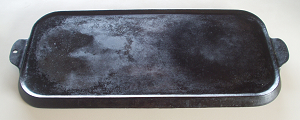
    I have done this only one time. I bought a cast iron griddle on ebay and it came covered in crusty bits all over the cooking surface (I suspect that this is because the previous party did not use the right kind of spatula). Folks that get brand new cast iron with "seasoning" (that has more to do with marketing, shipping and profit margins than what you want) really want to get that gick off.

    While I have read of many ways to do this, the technique I went with was to toss it in the fire. We have a stove for wood heat. It was a cold night and so a fire was burning. When the fire got to the point of being just coals, I tossed the crusty griddle on the top. The next morning I fished it out. All of the crusty stuff had turned to ash. I brushed the ash off with my hand, then dribbled a little oil on it and wiped that all over the griddle with a paper towel. Then I started using it. It worked fine. Note that I did not do any seasoning involving an oven - the seasoning has built up just fine without that.

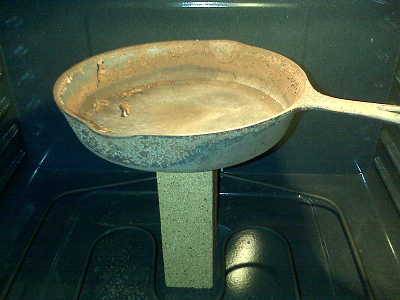
    I got a fascinating e-mail from "Shannon in NC" telling me about how you can start a pan over by using a self cleaning oven. I've heard of this about a half dozen times in the past. I've also heard of some people saying they tried this and their skillet cracked. Since this is the most complete information I have seen on this topic, I'm posting it here:

        I stumbled on to your info about cast iron cookware and wanted to let you know my experience with the self cleaning oven method. There isn't another method in the world that can beat it! I have used oven cleaner (yuck), sandpaper, even a drill powered rotary wire brush and NOTHING even comes close to how clean a self cleaning oven gets it.

        Out of curiousity, I had called my oven manufacturer last month wanting to know exactly how hot it gets and was told around 900-950 degs during the (roughly) 3 hr cycle. It reduces everything to ash which is easily wiped off. However, when you first open the door, don't be alarmed if the pieces look terrible. The ash residue is rusty looking and can be quite thick, but after a good washing the piece looks almost brand new. If you want to take a piece back down to the bare metal and start over with the seasoning process, this is the way to go. It even loosens rusted areas. You can scrub them with steel scrubbies beforehand if you want to cut down on the smoke or you can put the pans in as is and let them smoke a lot - but either way they will turn out the same. Spotless.

        Since leaving the racks in the oven will turn them dark and change the finish on them, I take them out. Be sure and remove any aluminum foil as it can melt or burn in the high heat. The pans need to be placed on something, not sitting directly on the bottom of the oven, so you could stand some bricks up on end and put the pans on those, one brick per pan. I wouldn't trust anything that says it's oven safe, though, because "oven safe" items are only safe up to 500 or 550 degs, not the 900-950 during the cleaning cycle. What ever you use to prop the pans up must be dry - this is extremely important. Any trapped moisture in a brick can change to steam and explode in high temps! If you aren't sure if it's dry, leave it in the oven set on the lowest setting with the door cracked for a few hrs to be certain. This cannot be stressed enough. Personally, I use the kiln posts for my ceramic kiln (I am a part time potter), but I doubt many people would want to buy a special post just for cleaning cast iron cookware. The posts are really cheap, though; less than a dollar each. If you did a lot of restorations it would be worth it.

    I replied asking for permission to put this here and got one more tidbit of useful information:

        I was thinking of other items that could be used to set the cast iron cookware on while going through the self cleaning cycle and ceramic coffee cups came to mind. As a potter, I do know that the temps reached in the cleaning cycle can not harm a ceramic item in any way and would be something almost everyone would have available to them already. Using a coffee cup would also help avoid the dangers of trapped moisture.

    Which oil or grease to use?

    I think that any edible fat will probably work fine. Oil, lard, shortening, animal fat, butter, etc. I'm still doing a lot of experimenting and asking around. Lately, I've been favoring the use of bacon grease - the kind that is saved after frying bacon. I think a big part of this is that it is solid at room temp. Somehow, I think that that makes it harder and slicker as a seasoning. Some people have said that the salt in bacon grease can cause pitting of the cast iron surface!

    I tried olive oil exclusively for a few months. If the pan needed scrubbing, it seems that the scrubbing would take off some seasoning! I could see fresh cast iron (silver color - not black!).

    Some people swear by shortening (Crisco). But I've heard some scary things about shortening, so I avoid it myself.

    Here's a great quote I found at homesteadingtoday.com:

        I inherited my mom's fifty year old cast iron, and for a few years I always used crisco on them. I had pretty good results, most of the time, but once in awhile something would stick.

        Last year I finally made some lard and we have been using it ever since on all of our cast iron- it is so much better than crisco. (I won't even address the use of veggie oils here, lol).

        Our pans have a beautiful, deep black finish that is a hundred times better than any non-stick finish you could buy. It also helps that we use the pans frequently. I'll never go back to crisco.

    My obsessive searching for information on this led me to this page which compares many different oils for their different strengths and weaknesses. Of note is "Grape Seed Oil" where they make the following comment "One caution: it's a fast drying oil so you want to clean up splatter right away because cleaning will be a lot harder in a few days. On the other hand, this makes it very good for seasoning bare steel and cast iron cookware." - this is the only oil where they even mention cast iron.

    So I tried grape seed oil for a couple of months. Everything started to get a gummy residue on it. I have switched back to sunflower oil and bacon squeezins. I'm looking around for organic lard (since I'm not raising pigs right now).

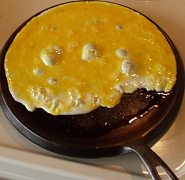
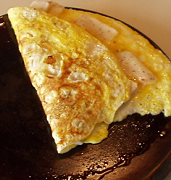
    Let's fry some eggs!

    For most folks, this is the big test. When I first started tinkering with cast iron, I thought "I just season the skillet and then the eggs won't stick!" When the eggs stuck I figured I must have seasoned it wrong. So I reseasoned that skillet about a dozen times and sometimes my eggs would stick and sometimes they wouldn't. I started looking for more information on the internet. The gold mine was forums. People offered tons of advice. I'm pretty sure that I currently use all of the advice I was ever given. At times I try to skip some of the advice only to discover that every little bit helps.

    1) Pan history.

      a) Properly seasoned at least once.

      b) Oil/grease has been used regularly. I don't use oil/grease for pancakes, but there is a tiny bit of oil in the pancake batter. I think it somehow comes out of the pancakes as they are cooked.

      c) No soap or scrubbing for the last several uses. Sometimes something happens and you need to scrub. And the next time you try to use it, it just doesn't seem as slippery.

      d) Used recently (a few days without use and it starts to get kinda sticky).

    2) Use oil/grease. It doesn't have to be a lot. One teaspoon should be plenty. Try to spread it around evenly.

    3) Preheat. Maybe about three minutes? I've found that medium, or a little lower than medium is the right temperature for almost everything. Somebody told me that if you flick a little water on the surface, that if the water dances, the skillet is ready!

    4) Never let the oil/grease smoke! Once it smokes, I think it turns into some kind of glue! If it has just started to smoke, you can add a little more oil and get your eggs in the pan right away!

      I've recently found that the very best time to put the eggs in is the moment is starts to smoke. Although it is true, that if you go a minute past this point, the eggs will fuse to the skillet.

    5) Add spices before the eggs. If you are using a little salt and pepper, sprinkle that on the cooking surface before the eggs.

    Cleanup

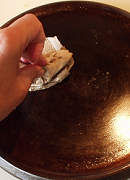
    Most of the time, everything slides right out. Sometimes I used the perfect amount of oil/grease and no cleanup is required. Usually, I'll use a paper towel to mop up a bit of excess oil/grease and take out any leftover food bits. As long as the pan looks clean with a thin film of oil on it, it's ready to be put away!

    Sometimes something sticks to it and a bit more cleaning is required. The first thing that rolls through my mind in this case is to figure out why it stuck and see if there is a way to prevent that in the future.

    It's worth saying again: NEVER USE SOAP! I've read where some folks use soap and are happy. But I know that some folks wash their dishes in such a way that if you get a glass of water you get a bunch of soap bubbles in your water - they think this is fine. I don't. I also think (and this is just speculation) that soap is going to remove seasoning.

      I'm such a putz.

      Use soap if you want.

      This concern comes from folks that tried to make soap in cast iron containers. All soap is made using lye. The lye will destroy the seasoning layer. Lye is a really nasty substance and the only reason I have never tinkered with making soap. Once the soap is made, there is no more lye danger. You can even use soap on your skin. Lye on your skin will probably take your skin off. The bottom line is that soap and detergent used on cast iron will not harm the seasoning layer.

      Another concern about soap is that the soap will stick to the oils due to how the soap molecule works. This may be true with oil in a liquid state, but not for oil in a polymerized state.

    The mission here is to try and get the yucky stuff out and leave as much of the seasoning on the pan as possible. It is possible to scrub away the seasoning. So, try the gentler approaches first.

    One neat trick that works most of the time is to put a quarter inch of water in the pan and boil the water in the pan. About 80% of the time, whatever was stuck just lets go. Pour out the water and then wipe out the pan.

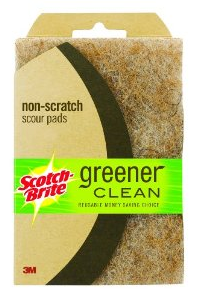
    If you have to scrub, I use plastic scrubber things. I like the kind that is a green rectangle about a quarter of an inch thick. Using a metal scrubby thing is going to take off the seasoning. I think that any kind of scrubbing is going to take off some seasoning - so the trick it to take off all the food bits and leave as much seasoning as possible.

    If you ever use any water, make sure that you thoroughly dry out the pan right away. Otherwise you will get rust! I usually put it on the stove, set the burner on high for a minute or two, and when all of the water is gone add a thin layer of oil/grease. Just enough to barely cover the inside.

    Don't leave food in the skillet. Acids in the food will pit the surface of your skillet.

    Odds and ends

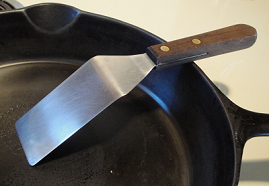
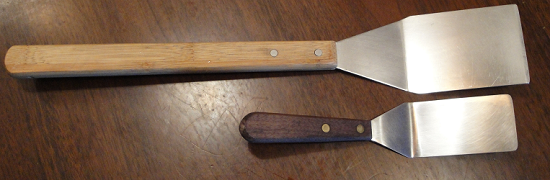
    I prefer to use a stainless steel spatula (aka "pancake flipper") with a very flat edge. I think the hard, sharp, flat edge scrapes off any seasoning bumps - thus making the cooking surface smoother. I'm amazed at how hard it is to find a stainless steel spatula with a flat edge. I ended up finding a huge one intended for use with BBQ stuff. But it also has sharp corners. The one at the right looks much better (and cheaper!) than the one I have.

    Calphalon 14.25-in. Stainless Steel Tools Slotted Spatula

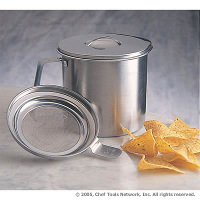
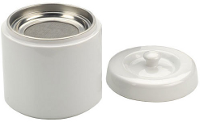
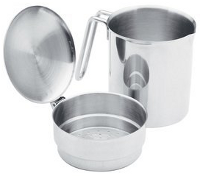
    When cooking bacon, I like to save the grease, then use the grease later for eggs, or corn bread, or whatever. This is the way my grandad did it. He had a little metal container that had a sort of filter at the top. Without the filter, sticky, chunky bits end up in your grease and leads to cleaning hassles. I found a similar contraption that I like much better than the one my grandad had. Mostly becase it is stainless steel and I think my grandad's was aluminum. But this one also uses a screen for a filter instead of a .... well ... pan-like thing with a bunch of holes in it.

    If you use the grease regularly, you can keep it on the counter - just a little ways away from the stove. Otherwise, you should probably keep it in the fridge.

    4-c. Grease Keeper

    Questions or Comments? post in the forum!


Copyright © 1986-2007    | home |